Tuesday, October 28, 2008

At Capacity


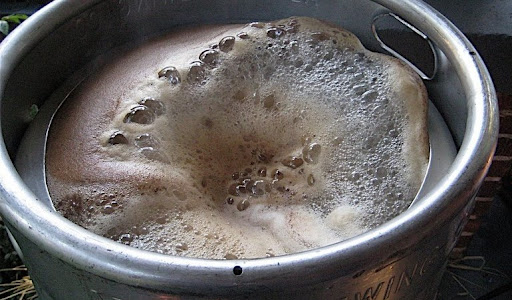
In case anyone's wondering, this is what 13 gallons of hot-breaking wort looks like in a half-barrel brew kettle:


That's a double batch of Smoked Porter in progress. Semi-coincidentally*, this batch also pretty much maxed out my mash tun with its 24 pounds of grain. I only had room for about 1.5 gallons of mash-out water, meaning I actually had to supplement my two batch runoffs with a one-gallon mini fly sparge during the second batch.

Not complaining, mind you. Two batches of Smoked Porter are now bubbling away happily with the aid of two different yeasts, and one of 'em will probably get dosed with bourbon. Oh, blessed be the fruits of our labor...

* I say "semi-coincidentally" because O.G. has a lot to do with that.

Wednesday, October 22, 2008

Zat's All Folks


And so disappears what could be considered the paradigm of a controversial era in the history of American brewing.

Zima, the much-maligned but for a time much-consumed standard-bearer of the "malternative" craze of the late 90s-early 2000s, is no longer in production and will start disappearing from store shelves as this year turns into next, MillerCoors has announced.

How many high schoolers furtively cut their teeth (especially their sweet teeth) on un-beers like Zima and Mike's Hard Lemonade? (I always had trouble excusing the sickly sweetness of these beverages just for the sake of a buzz. And drinking enough to actually achieve your goal? The nausea rises just thinking about it. Make mine Southpaw, if it comes to that.)

No word from MillerCoors if carb-watching among American teens is to blame for Zima's demise.

Sunday, October 12, 2008

The Flared Pilsner


As mentioned in this space already, the Pilsner glass is a rather broadly defined category of beer-drinking equipment. (Just click here and you'll see.)

What we have here is a Pilsner glass that, while not especially common, should not strike experienced beer folk with its novelty, either.

Like other Pilsner glasses, this one is tall and slender – a good shape for showing off the golden, sparkling aesthetics of its namesake brew. But from a functional standpoint, this piece of glassware falls short of other options due to its pronounced flare at the top. Good for capturing neither head nor aroma for any length of time, the out-turned lip ill-serves the well-poured Pilsner in that regard, although it does, at least, deliver the gilded brew easily and gently into a waiting, salivating mouth.

No surprises here as to which beers are best offered up to the flared Pilsner glass: German and Czech Pils; plus other light fare like Helles, Dortmunder and Kölsch – though be aware you may be breaking convention here. (And since head retention and aroma are nonexistant anyway, why not an American Lager?)

But let it be said: There are better places to put your Pilsner.

Thursday, September 25, 2008

Brilliant! Stout


Dry Stout is a misunderstood style, particularly when the general public is involved. (But isn't that always the case?) Sometimes called Dry Irish Stout due to its historical connection with and popularity on the Emerald Isle (Guinness, Murphy's and Beamish, Irish all, are the examples perhaps most likely to come to mind, in that order), here's a beer that tends to be light-bodied and low in alcohol (the three aforementioned brands being no exception) and yet is widely perceived as being the exact opposite – big, heavy, strong, overpowering.

Why? The first reason, of course, would be the color – jet-black and intimidating, not like those friendly, easy-drinking mega-lagers folks are used to. Then there's the flavor – strong (that is to say, existent), roasty, quite bitter. And finally the mouthfeel – a blend of CO2 and nitrogen (something many commercial examples, including the three above, feature) imparts a creamy, velvety texture to Dry Stout that is often taken for thickness, heaviness.

Of course, we homebrewers and beer snobs are wiser than this. Apart from its flavor – yes, Dry Stout is dark, coffee-like, rather bitter – there is in fact little in the way of alcohol content or body to put Dry Stout in the category of real heavyweights like Imperial Stout, Doppelbock and Barleywine.

Call Dry Stout session beer for a chilly day. Or for a hot day. Just don't call it "motor oil," and don't let your scaredy-cat pals call it that, either.

Here's my Dry Stout, very heavily based (hops and yeast being the differences) on a well-regarded recipe by Bob Girolamo.
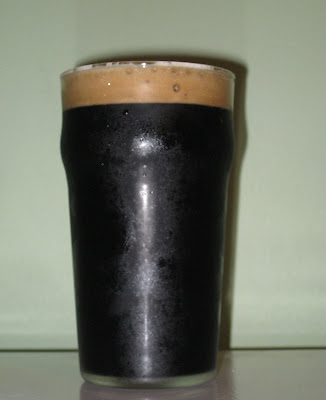
The details:

OG 1.056 FG 1.013
ABV 5.7% AA 76.5%
IBUs 44 SRM 33

80% Crisp Marris Otter
8% Flaked Barley
8% Roasted Barley
4% Crystal 120

1 oz Magnum 60 mins (44 IBUs)

US-05

As you can see, the alcohol content on this one is pretty high by Dry Stout standards. Partly that's because I hadn't gotten my mill yet so I had ordered precrushed grains from an online supplier. As such, I wasn't sure what kind of efficiency to expect, so I wanted to err on the high end with my order. (I ended up with ~74% efficiency. Not bad.)

The name, selected by my girlfriend, is an homage to the recent Guinness advertising campaign, although I will note that this brew was never intended as any kind of Guinness clone, and was served on just CO2.

Not surprisingly, based on accolades directed at Bob G.'s recipe, this one turned out very tasty. A big hit among my girlfriend (who loves Dry Stouts) and everyone else who came over to sample it. I didn't perform any experiments on dyed-in-the-wool light-beer drinkers, but based on my friends' feedback (surely they're not just being polite??) I'd venture to say Dry Stout's potential for wide appeal is not to be underestimated.

On a more somber note, this particular beer didn't make it through a recent party. It had a good life, and put many a smile on many a people's face. Wish I had a glass right now...

Sunday, September 7, 2008

Crazy Hot Break


Look what was churning around my boil kettle today. This has got to be the craziest hot break I've seen – big clumps of coagulated protein that look like angel hair pasta. (John Palmer has described it as "egg drop soup.")

The grain bill was nothing but Canadian Two-Row – 16 lbs. of it for a 10-gallon batch.


Click on the images for a larger view.


Friday, September 5, 2008

The Session #19 – Deutsches Bier

Been meaning to do this Session thing for a while now, but dammit if I don't forget every month. And it almost happened again, but for a chance visit to Lew Bryson's blog today that jogged my memory.

This month's theme is "Deutsches Bier" – German beer – and how the world is a better place for it. (And it is, thank you.) Our September Session is being hosted (and shortly, aggregated and summarized) by lootcorp 3.0.

I'm tempted, really tempted, to use this opportunity to rail against Germany's famed Reinheitsgebot, a.k.a. "German Beer Purity Law" of 1516. I'm tempted to point out that it's an outdated (by, oh, around 500 years) piece of legislation whose original purpose was to protect the production of bread, not beer. Tempted to point out the fundamental flaw in this attempt to fix the acceptable constituencies in beer before we even knew about yeast. Perfectly tempted to go on about stifling creativity, expression and the free market for no good reason. I'm tempted to do all these things, but I won't. I'll leave that to this guy.

If we are to equate wild, rambunctious and unrestrained brewing practices with greatness (can you say "Belgium"?), then maybe we ought also to bemoan the Reinheitsgebot for keeping one of the world's great brewing traditions needlessly handcuffed and kept from achieving its true potential.

On the other hand, how about arguing that by forcing German brewmasters to limit the scope of their focus, perhaps, and by instilling a strict adherence to the doctrine of "beer purity," maybe that silly old law is to be thanked for the roster of outstanding, technically masterful beer styles Germany has to offer today.

Ooof. Such philosophical and academic exercises are downright meaningless when you're in the streets outside Zum Uerige, sipping fresh Altbier poured from a firkin. Or downing beautiful golden Helles from a giant mug in the Augustiner Biergarten. Or enjoying barbecue with a smokey, velvety, seductive Rauchbier. Or fighting back the pucker instinct gifted by a gloriously sour Berliner Weisse. (Take that, Belgium.)

Germany, I say give me your Doppelbocks, your Dortmunders, your Schwartzbiers. Your Weizenbocks, your Kölsches, your Märzens.

Let's be honest – how often do we demand that our beers have adjuncts and extraneous flavorings in them? What's in an IPA that would offend the German Beer Police? (You thought I was going to say "Beer Nazis," didn't you?)

The Olympics ended last month, so I hope you'll follow me on this: Without taking a moral stand on the Reinheitsgebot issue, we can step back and regard Germans beers like we do the Chinese athletes churned out from that country's gymnast-and-diver mills. Sure, there may be some government meddling involved here. OK, things might have turned out differently. But damn – they're still something to marvel at.

Saturday, August 23, 2008

Old Guinness


A friend of mine recently gave me some old beer he had going to waste in the back of his fridge. In the course of a conversation, it was revealed that some folks had brought beers to his place for a party, and that the brews had been sitting there, all alone and quenching no one's thirst, for a while. The time had come, he declared, to toss them out.

I might as well have been a dog rescuer who'd just heard an adorable Shih Tzu was about to be put down. Immediately I volunteered to take the unwanted beers off his hands. My friend's bemused reaction bordered on disapproval, as if I had just betrayed a most pathetic length to which I'd go in the name of alcohol. These beers, he informed me, were most certainly ancient and well past drinkable.

I had to calmly explain that, first, beer does not spoil – many beers can become fairly unpleasant after enough time, but not harmful to drink. Secondly, I was interested in sampling these relics not in the name of catching a cheap and dusty buzz but as an educational experience. The beer geek in me (he has a say in a lot of things) wanted to know what effects age had wrought on these beers.

Receiving my friend's castoffs, I noted that they did indeed have a couple years on them. A bottle of Samuel Adams Boston Lager bears a "best by" date of September 2006. Assuming all of the beers took up residence in my friend's fridge at the same time (and I'm lead to believe they did), and assuming the Sam Adams was not on in years to begin with, that would put these brews at over two years old.

The haul included that Sam, a Carmel Wheat Beer (both of which I've not yet drank), a woefully insipid Bert Grant's Mandarin Hefeweizen, a Heineken with solid floaties and an unpleasant aftertaste (and of course I'm not blaming the beers here – these flaws came as no surprise), and two Guinness Draughts.

As I said, I assumed the age on these beers was two-plus years. Only the Sam has a date. One Guinness (pictured) has a code that appears to read "02L3." Not sure what, if anything, that means.

Now, considering the apparent age of this Guinness and its low alcohol (around 4.2% ABV), I'm a little surprised and pleased to report that it's not too bad. OK, so the bottle and bottle cap wore a little fridge grime. And the malt does seem to thin out some into an oxidized finish (something I'm not terribly sensitive to anyway), but then Guinness is also light-bodied already, creamy nitro-widget notwithstanding. The roast is there but not terribly strong, but the beer still retains a fair amount of bitterness (this being something else that typically wanes noticeably in older beers).

Would I have guessed this Guinness was so old? No, probably not. No doubt the fact that it and its brethren have been languishing in a refrigerator, and not on a store shelf or in a closet, has helped. On the other hand, let's not forget that the Mandarin Hefeweizen and Heinie presumably shared quarters with their Irish friend here.

I'm not about to recommend Guinness Draught as a cellarable beer. Yet, nor will I advocate that an aged sample should live out its final moments getting to know your kitchen sink. Remember, alcohol abuse is a crime in 17 states.

Related Posts with Thumbnails