Showing posts with label Germany. Show all posts

Thursday, March 11, 2010

Kölsch 2

My decision to brew another Kölsch had roughly two sources of inspiration: first, I have a sort of standing desire to keep something light and drinkable on draft at all times, even if I don't always follow through on that desire; second – and more acutely – I had been to visit the new outfit Olde Mecklenburg Brewery in Charlotte, N.C., and when I tasted their delicious, authentic-style German "lagered ales," I knew I had to make some of my own.

A chat with John, one of Olde Meck's very friendly and gracious co-owners, revealed that their Kölsner (a Kölsch with a little extra, Pilsener-style hopping) and Copper (a Düsseldorf-style Altbier) are both fermented with White Labs 029, a strain reputedly sourced "from a small brewpub in Cologne, Germany."

This was good news to me, for among homebrewing circles, the two styles are typically associated with distinct, if similar, yeast strains. Wyeast 2565 is seen as the paradigm of Kölsch yeasts, while for Altbier the choice is usually Wyeast 1007. I had worked with 2565 previously, and while it made an adequate Kölsch on my first and only prior attempt at the style, it did impart a bit more of a fruitiness than I prefer, even in a style that makes allowances for this character.

Given also my fondness for reusing the same yeast strain in a series of beers, I was further pleased to hear that a commercial brewery, in addition to the homebrewers who gave their own endorsement of the idea, had no trouble at all making delicious Kölsch and Alt with WLP029.

With plans already hatching to follow this up with an Altbier, and a Sticke Alt, and possibly the even the likes of a Foreign Extra Stout and a Baltic Porter, I set about designing my Kölsch recipe*:

OG 1.050 FG 1.009
ABV 5.4% AA 82%
IBUs 25 SRM 3

8.75 lbs. / 92% North American Pilsner
0.75 lbs. / 8% German Munich

0.63 oz. / 22 IBUs Magnum – 60 mins
0.38 oz. / 3 IBUs Santium – 10 mins

White Labs 029 "German Ale/Kölsch Yeast"

* The ingredients here actually represent 50% of what was used during this brew session; this was part of a double batch, the other half of which became a Belgian Blonde Ale following a simple-sugar addition.

The Kölsch was fermented at a wort temperature of around 63°, with a primary fermentation length of 20 days. It tasted great already following only around 2.5 weeks of lagering/carbonating, and at nearly three months old the beer still tastes great even if I fear it must certainly be nearing the end of its life.

The nose offers some light fruit esters including perhaps faint berries and even a whiff of mead-like fruitiness. The flavor is crisp and clean with apple-like fruit, a decidedly unobtrusive bitterness, and easy malt on the dry finish. It's pale gold and brilliantly clear.

Given the inherent difficulties with brewing a delicate style like Kölsch, and my inexperience with this particular yeast strain, I can't help but be pleased overall with how the beer turned out. Moreover, I remain very excited about my future adventures with this yeast – as I type 10 gallons of Alt are carbonating and I can't wait to see how that one turned out.

Friday, June 5, 2009

The Session #28 – Think/Drink Globally

For this month's Session, hosted by Brian over at Red, White and Brew we get geographical: Brian asked us to write about "the farthest brewery (including brewpubs) you have visited and specifically the best beer you had there."

A quick consultation with my memory banks and a map tells me it's Zum Uerige in Dusseldorf, Germany. That's about 4,350 miles from my current location in Columbia, S.C. For purposes of this exercise, farther still as I was living in Houston at the time of my visit – that's a 5,130-ish-mile trek.

The best beer I had there? Naturally, that would be ZU's famous Altbier, served straight from the cask outside on Berger Straße, in the picturesque, stone-paved setting of Düsseldorf's Altstadt. I've hinted at my affinity for Altbiers before, with ZU serving as some not-so-insignificant inspiration (not that my homemade crack at the style came anywhere close).

Liz enjoying ZU Weisse on Berger Straße

The Altstadt (literally, "Old Town") section of Düsseldorf is known for its picturesque buildings, its side streets crammed with bars and restaurants, its view of the Rhine, and of course, its tasty Altbier. Sadly, I did not visit the other Alt-producing brewpubs in the area – Im Füchschen and Zum Schlüssel round out the Altstad trio; Schumacher, the oldest such pub, is not far away – but did sample some of the other commercial examples – Frankenheim and Schlösser, if I recall. (Boy, sounds like I didn't exactly take full advantage of my visit to one of the world's great beer cities, eh?)

Nor did I spend much time inside Zum Uerige itself, such was the pleasantness of the scene outdoors. Had I taken more than a brief walk inside, I might have seen where that shiny new brewing equipment being moved into the building via crane was headed. (Left: Here I am standing next to some.) The interior of the building is quaint, pub-like and old-timey, with wood everywhere and an intimate feel, befitting its Altstadt surroundings.

So what would a return trip to the Düsselforf region call for? Doubtless, a closer look at the historic Alt breweries that give us such wonderful German ale. And how about a short trip south to visit neighboring – and big-time rival, so they say – Köln (Cologne to us Anglophones), another of Germany's historic brewing centers and home of the delicate, lager-like Kölsch. In a land prized for its stellar lagers, it's remarkable that such a relatively small slice of Germany has given us two of the world's great ale styles. I'd say that's worth the trip for any beer traveller

Spent grain is hauled out to the sidewalk in large bins. Some of it stays behind.

Tuesday, May 12, 2009

The Warsteiner Maß

Have I mentioned my fondness for German beer? I believe so. It's not just that the Germans make a diverse range of extraordinary beers. It's not just that Germany has given us some of the world's great beer styles. Heck, it's not even just because the Germans, rightly or otherwise, refuse to brew with adjuncts or other flavorings and reliably churn out quality and variety in spite – or, more probably, because – of this.

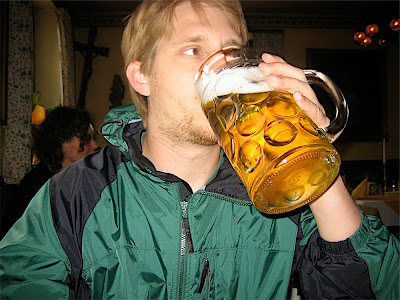
These are all good things, and any single one would compel our admiration. But on top of all that, you've just got to love German beer because Germans love it so much, too. Need proof? Check out this big honker of a beer mug brought to us by Warsteiner, at one liter in capacity a veritable bucket of joy and an apt physical representation of the Germans' legendary thirst.

In its native land, this voluminous mug and others like it go by the name Maß (pronounced "mass"), which is short for Maßkrug. Stoneware or glass, decorated or otherwise, the Maß can come in any number of configurations (here I am drinking from the commonly seen dimpled version), though the constants tend to be its ample volume – one liter – and its handle.

In and around Munich, where grand beer halls and gardens typify the German taste for high-volume beer service and consumption, the roomy Maß further obliges this penchant in appropriate fashion.

And this is to say nothing of Oktoberfest, the world's largest beer-drinking party, wherein natives and foreigners converge on Munich to hoist Maßkrüge (approximately 7 million liters' worth!) in unapologetic indulgence of world-class beer. Take away the Maß, brimming with beer and joyfully swung side to side by hearty revelers, and our image of Oktoberfest, the zenith of Germany's propensity for beer appreciation on a large scale, would hardly be the same.

The Maß is most often used for your everday-drinking beer. In Munich, this is usually the delightful Helles, a staple of Bavarian beer halls and gardens, flavorful enough to demand all-day consumption yet light enough in alcohol to allow it. The Warsteiner Maß pictured above, meanwhile, is intended for use with that brewery's signature Pilsener. During Oktoberfest, as you might imagine, Oktoberfestbier is the brew of choice, which these days displays less of the amber color and maltiness of its cousin Märzen, instead tending to be light and Helles-like.

Wednesday, February 4, 2009

The Diebels Alt Glass

You think Germany, you tend to think lagers. It's understandable – we're talking about the land of Helles, Pilsener, Dunkel and Bock. But in a place as rich in beer heritage and accomplishment as Germany, the native top-fermented beers likewise merit our acknowledgment and appreciation.

No doubt, the most obvious such examples are Hefeweizen, the renowned wheat beer of Bavaria, and its derivatives (Dunkelweizen and Weizenbock, for example). There is also Kölsch, the pale, almost lager-like ale that dominates its home town of Cologne (Köln in German). The last major ale style in Germany is Altbier (Alt for short), a copper-colored, ridiculously tasty treat native to the German state of North Rhine-Westphalia, and in particular its capital Düsseldorf.

I'll avoid delving into too much history and description of this style (for that, visit the always fantastic German Beer Institute), but suffice it to say the name "Alt" itself hints at the longevity of this beer style while its flavor attests to the collective versatility of Germany's brewmasters, past and present.

Perhaps the most famous Alt comes from Zum Uerige, one of a handful of Alt-producing brewpubs in Düsseldorf's charming "Old Town" section. It is here where locals and reverent beer travelers gather on outdoor picnic tables to enjoy nectar like ZU's Alt, sometimes gravity-drawn from casks, and sipped from straight, cylindrical glasses called "bechers." (Similar to the "stange" used to drink Kölsch.)

The particular glass seen here, from Brauerei Diebels in Issum, may not represent the "typical" becher-like shape that other Altbier producers opt for, but as the official glassware of a major Alt brewer, it is worth taking note of.

Notice the tall, slender body that widens on its way up. This makes for a fine presentation (see it full) if not the best means of gathering up head and aromas.

Nevertheless. There is plenty to admire about authentic German Altbier and those who brew it. So hoist your becher or Diebels glass and toast a national brewing tradition rivaled by few in terms of history, breadth and consequence, and a beer style that embodies that tradition.

Tuesday, January 13, 2009

The Weissbier Glass

Weissbier (in German, Weßbier) goes by many names: Wheat Beer, Hefeweizen, Weisse, Weizen, Weizenbier and Hefe are common variations. But proper German Weissbier, no matter what you choose to call it, is a staple of sun-dappled Bavarian beer gardens and the drinking hand of anyone looking for that frame of mind, and is as strongly connected with a particular glass as beer styles get.

Like the Bavarian barmaid you imagine delivering that frothy cup of goodness, Weissbier glasses are almost universally tall, curvaceous and of course brimming with radiant blonde beauty. They're typically sure-footed, with a slender midsection beneath a round, ample top. I'm sorry, are we still talking about glassware?

Hefeweizen is a good-looking beer (click here for proof), and its glassware, tall and shapely, compliments that aesthetic well. Highly carbonated, Hefe also benefits from the roomy upper reaches of this glass, allowing plenty of space for that fluffy white head a well-poured Hefe boasts.

(Confession time: I'm not a huge Hefeweizen/Weissbier fan. And not for lack of sampling. For whatever reason, while I can recognize quality, I have a hard time getting revved up for this style. I keep telling myself I'm going to brew some again to try and break my stubbornness.)

No surprise here, this glass is best suited for Hefeweizen/Weissbier/pick your moniker. And while I believe all beer should be drank from a glass, I think that's especially so with this style. Hefe should be poured to allow some of that exuberant carbonation go free, lest you get little more than an explosion of gas and bubbles in your mouth on every sip from the bottle. What's more, the delicate yet complex flavors and aromas of this style are best explored from the proper glassware.

One last quick note: There's nothing to prevent one from pouring other beer styles into this glass. Indeed, I know of at least one chain of beer bars that uses this glass for extra-large Happy Hour pours. Its tapered mouth helps collect aromas and flavors up top, so there's nothing particularly offensive about the design. I'd probably stay away from Belgians and high-gravity styles if only because the sheer volume of the Weissbier glass would put it out of range of such beers, which tend to be consumed in smaller servings. But lighter beers and American and British ales? The well-equipped beer drinker probably has better glasses to reach for, but otherwise...

Friday, September 5, 2008

The Session #19 – Deutsches Bier

Been meaning to do this Session thing for a while now, but dammit if I don't forget every month. And it almost happened again, but for a chance visit to Lew Bryson's blog today that jogged my memory.

This month's theme is "Deutsches Bier" – German beer – and how the world is a better place for it. (And it is, thank you.) Our September Session is being hosted (and shortly, aggregated and summarized) by lootcorp 3.0.

I'm tempted, really tempted, to use this opportunity to rail against Germany's famed Reinheitsgebot, a.k.a. "German Beer Purity Law" of 1516. I'm tempted to point out that it's an outdated (by, oh, around 500 years) piece of legislation whose original purpose was to protect the production of bread, not beer. Tempted to point out the fundamental flaw in this attempt to fix the acceptable constituencies in beer before we even knew about yeast. Perfectly tempted to go on about stifling creativity, expression and the free market for no good reason. I'm tempted to do all these things, but I won't. I'll leave that to this guy.

If we are to equate wild, rambunctious and unrestrained brewing practices with greatness (can you say "Belgium"?), then maybe we ought also to bemoan the Reinheitsgebot for keeping one of the world's great brewing traditions needlessly handcuffed and kept from achieving its true potential.

On the other hand, how about arguing that by forcing German brewmasters to limit the scope of their focus, perhaps, and by instilling a strict adherence to the doctrine of "beer purity," maybe that silly old law is to be thanked for the roster of outstanding, technically masterful beer styles Germany has to offer today.

Ooof. Such philosophical and academic exercises are downright meaningless when you're in the streets outside Zum Uerige, sipping fresh Altbier poured from a firkin. Or downing beautiful golden Helles from a giant mug in the Augustiner Biergarten. Or enjoying barbecue with a smokey, velvety, seductive Rauchbier. Or fighting back the pucker instinct gifted by a gloriously sour Berliner Weisse. (Take that, Belgium.)

Germany, I say give me your Doppelbocks, your Dortmunders, your Schwartzbiers. Your Weizenbocks, your Kölsches, your Märzens.

Let's be honest – how often do we demand that our beers have adjuncts and extraneous flavorings in them? What's in an IPA that would offend the German Beer Police? (You thought I was going to say "Beer Nazis," didn't you?)

The Olympics ended last month, so I hope you'll follow me on this: Without taking a moral stand on the Reinheitsgebot issue, we can step back and regard Germans beers like we do the Chinese athletes churned out from that country's gymnast-and-diver mills. Sure, there may be some government meddling involved here. OK, things might have turned out differently. But damn – they're still something to marvel at.
Related Posts with Thumbnails