Showing posts with label Brewing. Show all posts

Wednesday, December 16, 2009

Double Brew, Deep Into the Night

It's not often that laziness lets me down.

But it sure did this past Sunday when, still in the midst of shaking off the previous night's indulgences and waffling over whether I actually felt like brewing, early- and mid-afternoon came and went before I pulled my act together and got moving on a double-batch brew I'd been planning for a while. (And one that, otherwise, would have had to wait until the new year.)

So it was dreary, drizzly and dimming as my strike water heated up, and the mash was conducted under cover of dark:

Well behind schedule already, things weren't about to improve. The mash temperature came in lower than planned, and it took several boiling-water infusions to bring it up. After the sparge, more time was chewed up bringing all this extra volume to a boil – I finally got action just shy of 8 o'clock. And of course, all that liquid meant a longer chilling time than my usual five-gallon affairs.

The yeast were pitched after 10 p.m. and cleanup didn't wrap until close to 11:30. But, as always, any fatigue or annoyance had been largely supplanted in importance by that sense of accomplishment and excited anticipation (colored with a tinge of anxious uncertainty) that comes from having fresh wort in the fermenter, ready for magic to be done upon it.

On top of its nocturnal novelty, this batch was special for its experimental nature. Using the same grain bill and hopping schedule, I split the 11-plus gallons of wort in two for purposes of making two entirely different beers: One, a Kolsch fermented with White Labs WLP029; the other a Belgian Blonde Ale using WLP530.

To account for the higher original gravity and simple-sugar addition employed in the making of Belgian Blondes, I had pulled off about two quarts of wort most of the way through the boil and added to that 1.25 pounds of sucrose (table sugar). That was chilled and added to the Belgian wort as I drained the kettle. Other than that and the yeast strains, the worts were identical: in total, 17.5 pounds of Pilsner malt; 1.5 pounds of Munich; 26-ish IBUs from Magnum hops; and another 0.75 ounces of Santium hops at 10 minutes for the heck of it.

Both batches are now fermenting away happily. The Kolsch (left) is puffing along at around 62 degrees; the Belgian at closer to 66, though I have plans to let that warm up.

Time and tastebuds will determine whether this little experiment was worthwhile. The upshot is twice as much beer for not much more work; the risk is winding up with 10 or more gallons of substandard stuff. This was not my first (nor my second) double-sized batch, but ordinarily I stick to single-fermenter brew days. But then, I also tend to stick with brew days as opposed to nights. Though it would suit my laziness, for the sake of everything else let's hope darkness doesn't prove to be any kind of magic ingredient.

Update: Kölsch recipe and evaluation

Tuesday, November 3, 2009

Orval Dregs at Work

I had been extremely excited about my upcoming run of Belgian-style beers, all to be brewed one after another (no non-Belgians in between) and using the same esteemed yeast purportedly sourced from the Trappist brewery Westmalle (and also used by Achel and Westvleteren). Inching up in alcohol, from Belgian Pale Ale to Dubbel to Tripel, this was to be, admittedly, my most ambitious (in terms of uninterrupted focus) series of Belgians yet created.

Well, here we learn, by inverse anyway, of the value of practice and experience in brewing. Being my first time with this yeast, and in some cases with the style, an unfortunate possibility came to pass when none of the three beers came out quite as good as I'd hoped (the Pale Ale being the least offensive of the three), with an unfortunate phenolic bite being a hallmark showing through most clearly in the Dubbel. (The Tripel, for its part, at this point remains so alcohol-laden as to accomodate fixation on little else. Many bottles of it, and the other two, have been squirreled away where neglect and age will hopefully bestow their favor.) Brewing all three in succession did not afford the chance to apply lessons learned within the course of this three-brew series; doing so will have to wait until next time.

In an effort to (1) turn something unspectacular into something potentially interesting, (2) free up space among the taps, where I faced the unappealing prospect of having to trudge my way through mostly full kegs or let them sit and hope things improved, and (3) provide an excuse to buy and drink a beer I don't have often enough, I blended the remnants of the Pale Ale and Dubbel into a carboy (with a dash of Black IPA added for extra bitterness and flavor), created a small amount of additional wort, and pitched into it a starter of cultured-up Orval dregs from two bottles.

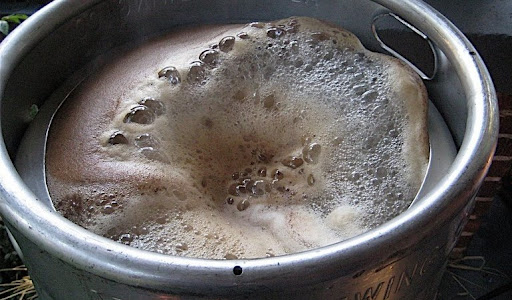
Here is what things look like a little more than 48 hours into the experiment:


Note the rather sizeable mat of krausen. This tells me one thing primarily: Orval dregs must not contain simply the "wild" yeast Brettanomyces that helps to lend the beer its signature flavor, but some strain of Saccharomyces as well. Indeed, this much has been speculated upon on brewing forums and even suggested on the Orval Web site itself. I say this because Brett is understood to be a relatively slow worker (activity here kicked off in a matter of hours) that creates a pellicle on the beer's surface.

The addition of around 0.5-0.75 gallons of fresh wort will provide the Saccharomyces and Brett more sugars to consume and assert themselves (while also hopefully countering somewhat the off flavors of the previous fermentation). Additionally, this new wort was given about 2 ounces total of late hops – a small 5-minute addition of Santiam and a flameout addition of Santiam and Mt. Hood that was steeped. This again was intended to provide additional complexity to cover up off flavors while also serving as a nod to Orval's notable late hopping. I think the unusually dark surface of the krausen may owe to this extra hop matter being pushed up to the top. My Frankenstein's monster might be dry-hopped as well, like Orval is.

There's no telling how this odd amalgamation of mine will turn out. My hope is the Brett will impart enough funky goodness to overcome the previous yeast's footprint, while further drying out the beer and helping to accentuate the newly added hops. Did I mention this is my first foray into the use of "exotic" strains like this? Doubly exciting.

Tuesday, October 28, 2008

At Capacity


In case anyone's wondering, this is what 13 gallons of hot-breaking wort looks like in a half-barrel brew kettle:


That's a double batch of Smoked Porter in progress. Semi-coincidentally*, this batch also pretty much maxed out my mash tun with its 24 pounds of grain. I only had room for about 1.5 gallons of mash-out water, meaning I actually had to supplement my two batch runoffs with a one-gallon mini fly sparge during the second batch.

Not complaining, mind you. Two batches of Smoked Porter are now bubbling away happily with the aid of two different yeasts, and one of 'em will probably get dosed with bourbon. Oh, blessed be the fruits of our labor...

* I say "semi-coincidentally" because O.G. has a lot to do with that.

Sunday, September 7, 2008

Crazy Hot Break


Look what was churning around my boil kettle today. This has got to be the craziest hot break I've seen – big clumps of coagulated protein that look like angel hair pasta. (John Palmer has described it as "egg drop soup.")

The grain bill was nothing but Canadian Two-Row – 16 lbs. of it for a 10-gallon batch.


Click on the images for a larger view.


Saturday, May 17, 2008

Craft Beer on NPR


Beer, brewing, and homebrew were the topics of yesterday's Science Friday on NPR.

Check it out.

Friday, May 2, 2008

Beer and Wood


Here's a brief writeup on wood-aged beers in The Washington Post. The massive Dogfish Head aging tank has me intrigued...

Friday, February 1, 2008

Berliner Weisse


So what happens if you just love sour beers but aren't ready to let a bunch of wild microorganisms loose in your brewery?

Why, you cheat, of course.

And so it was with my first attempt at a Berliner Weisse (see also this great page), which also marked my first attempt at (intentionally) producing a sour beer at home. I know the purists will squawk, but without a dedicated set of plastic equipment (bucket, hoses, autosiphon ...), I wasn't about to expose the regular stuff to the potentially invasive lactobacillus bacterium.

What I did, instead, was ferment the beer with a fairly clean yeast (in this case, Wyeast 2565 "Kölsch") and then hit it with some food-grade lactic acid at kegging time. I'd read about this technique (and its efficaciousness) in Daniels' "Designing Great Beers" and elsewhere.

Here's the full skinny:

OG 1.036 FG 1.005
AA 86% ABV 4.1%
IBU 8 SRM 4?

64% German Pilsner
36% German Wheat

8 IBU Tettnang 45 min.

Wyeast 2565 "Kölsch"

74 mL (2.5 oz.) food-grade lactic acid at kegging

Brewed Dec. 16
Crash-cooled Jan. 7
Kegged Jan. 8
Tapped Jan. 16-17-18?

I tried to perform a two-step infusion mash with rests at 140 and 151 but I had a hell of a time hitting my temps so I ended up having more intermediate steps than planned. This could have something to do with the incredibly fermentable wort that resulted. That's OK -- this beer is supposed to be dry.

I used 2565 because a) I had it on hand, b) Wyeast's Web site endorses this use for the yeast, and c) in the Kölsch I found it to be mostly clean with a little fruitiness -- just right for this application.

I'll say again that my procedure was far from traditional. Basically I took the idea of the final product -- a light, refreshing wheat beer with a strong sourness -- and then figured a way to do it. Plenty of people go the other way: Follow the "traditional" procedures to the letter and hope you like what you get. The theory, of course, is that you will.

I know someone who brewed a best-in-show Berliner Weisse by tossing a handful of grains into a bucket of wort. No yeast pitched. This is one method. You can also buy lacto cultures from the major yeast vendors. You can also perform a sour mash. Some procedures call for no boil. Etc.

Also, traditionalists will tell you Berliner Weisse should be bottle conditioned so as to achieve the "required" level of high carbonation. This, they'll say, contributes to the dryness and refreshing nature of the beer.

There are reasons to avoid such a dogmatic approach, at least in my case. One, I don't like very highly carbonated beers, no matter how much "to style" that is. Also, I don't like bottling. Finally, I prefer having my beers on tap so I can pour as much or as little as I want and not have to commit myself to exactly 12 oz. Especially with a sour beer, one might not always be in the mood for that size serving. (But who am I kidding -- why wouldn't I be?)

The beer itself did indeed turn out light, crisp, dry, refreshing and sour. The sourness is mostly evident on the finish with some mild puckering. It's a very clean, acidic sourness, not entirely unlike what you get from a Granny Smith apple. (I wonder if this has anything to do with Lactobacillus delbrueckii subsp. bulgaricus' ability to produce acetaldehyde.)

If anything, though, I'd say the beer didn't turn out sour enough. I like my beers really sour, and to me, this one is just moderate. Next time, I'll add more lactic acid to the keg -- maybe 1-2 ounces more.

I've only tried a real Berliner Weisse twice before so I can't say exactly how this compares. I remember the real deal being pretty intensely sour and quite good.

Too bad I can't cheat my way to a wonderful Gueuze!

Sunday, December 16, 2007

This Blows


I'm trying to brew a Berliner Weisse today and it's windy as hell. Light equipment is blowing all over the place. Add to that the cold (low 50s) and I've been having a hell of a time hitting target temps for this step mash.

Perhaps my wort will chill down faster ...?

Friday, December 7, 2007

SNPA (almost)

The Sierra Nevada Pale Ale clone has been tapped. Not my recipe, though -- it's from a poster on the Northern Brewer forum who goes by the name beerfan.

Here's the lowdown:

OG 1.053 FG 1.011
AA 78.3% ABV 5.4%
IBU 38 SRM 8

93% U.S. Two-row
7% Crystal 60

0.4 oz Yakima Magnum 60 mins (19 IBUs)
0.5 oz Perle 30 mins (10 IBUs)
1.0 oz Cascade 10 mins
2.0 oz Cascade flameout

US-05

Brewed Oct. 21
Crash-cooled Nov. 3
Kegged Nov. 11
Tapped Nov. 25

At first it was a little "homebrewy" -- probably from the last of the yeast settling out to the bottom of the keg. The flavor profile continues to clean itself up. I have yet to purchase some real SNPA to do a side-by-side comparison, but I'd suspect it's going to be pretty close. The recipe is, after all, "renowned" (in its own circle anyway) for being a fine clone. If anything, it's possible this beer's hop character is a little subdued compared to the version coming out of Chico.

I've personally felt in recent years that SNPA seems fairly mellow for an American Pale Ale (probably not the case that beer's changed -- just that my tastes have). As such, this clone attempt, especially considering it might fall further on the mellow side, might even be best classified as some sort of "aggressive" Blonde Ale.

But it's all academic. This is a tasty brew no matter what.

Monday, December 3, 2007

Check Your Thermometers


Not too long ago I brewed a beer, pitched my yeast, and thought all was going well. Then about eight days later I discovered fermentation had stopped well above where it should have (63 percent apparent attenuation versus the 78-81 I had been seeing with the same yeast).

I went and checked the thermometer I used to mash in and found it was reading five degrees higher than another one I had. I won't presume the second thermometer to be dead-on, but it does read exactly the same as my house thermostat, so I think it's in the neighborhood.

So what does this mean? I probably mashed closer to 160 degrees as opposed to the 155 I was aiming for. (And I only went that high because I thought the thermometer was actually reading high... HA!)

Moral of the story: check your thermometers. Don't take anything for granted. And if you suspect that a thermometer has been acting up on you and can't be trusted... you're probably right.

Wednesday, October 24, 2007

Chincoe IPA


Sometimes you just want a really hoppy beer, but you don't want to deal with a 9% alcohol Double IPA in order to get it.

With this in mind, I decided to make a beer hopped more like a DIPA, but with the malt bill of a regular-strength IPA. In other words, a perfectly hoppy out-of-balance beer. Not necessarily an original concept, I'm sure, but it seemed like a good idea.

So here's what I came up with:

OG 1.060 FG 1.011
AA 80.9% ABV 6.4%
IBU 81 SRM 8

68% U.S. Two-row
26% Munich
4% Dextrine
1% Crystal 60
1% Crystal 120

0.5 oz Simcoe FWH
1.0 oz Chinook 60 mins
0.25 oz Chinook 30 mins
0.25 oz Simcoe 30 mins
0.25 oz Chinook 20 mins
0.25 oz Simcoe 20 mins
0.5 oz Chinook 0 mins
0.5 oz Simcoe 0 mins
1.0 oz Chinook dry hop
1.0 oz Simcoe dry hop

US-05

So, you can see why I dubbed this "Chincoe IPA." Between the IBUs and the high attenuation, this one finishes dry as a bone.

Next time, I think I'll load up more on the late hop additions -- like two or three times the amount. Maybe more dry hops too. OK, and maybe more character malt. But like I said, it wasn't supposed to be balanced. Just an extra hoppy beer of manageable strength.

Saturday, October 6, 2007

Hittin' Us Where It Hurts


Consider this the ultimate cost-of-living increase:

Beer prices are set to rise, due to jumps in the cost of malt and hops.

Read about it in the Wall Street Journal.

We homebrewers are already familiar with this reality. After pondering a bulk hop purchase for several weeks, I finally decided to pull the trigger -- but not until after hop prices had, in some cases, skyrocketed.

I'm not usually a sky-is-falling kind of guy. But let's face it: some of the specialty ingredients that we homebrewers covet are produced on a very limited basis. We can't afford to see hop varieties disappear or undergo exponential price increases. As crops fail and growers turn to more profitable options like corn, will the laws of supply and demand be enough to encourage new growers to step in?

Wednesday, October 3, 2007

Kölsch

I'm pleased with how my Kölsch came out. I wasn't too sure at first -- it was a little too fruity and definitely too cloudy -- but two months of cold-conditioning really seems to have done the trick.

Here're the vital stats:

OG 1.051 FG 1.011
AA 77.7% ABV 5.2%
IBU 24 SRM 3

93% German Pils
7% Wheat malt

16 IBU Tettnanger 60 mins
6 IBU Tettnanger 30 mins
0.5 oz Saaz 10 mins
0.5 oz Saaz flameout

Wyeast 2565 "Kölsch"

Next time I brew this I'll omit the wheat malt because, well, I don't like wheat anyway and I don't think it adds much. I think the gentle fruitiness of the yeast softens it out enough -- I don't need any wheat in there helping out.

I'm also tempted to brew this with White Labs 029 "German Ale/Kölsch" yeast. I suspect it'll be a little less fruity. I know others are satisfied with 2565, and I don't have any reason to think mine didn't come out just about spot-on, but what can I say, I like my yeasts crisp and clean.

Maybe I should just brew a damn lager instead and not expect Kölsch to be something it's not...

The problem with this style (and lagers, certainly) is that I don't have a dedicated lagering fridge, so any beer that needs to cold-condition must do so in my kegerator, and therefore take up valuable beer space. I just don't know that I have the patience to stick something in there for two months and not touch it when I could have a keg there that's ready to be consumed.

Extra fridge, anyone?

More on Kölsch:

From the German Beer Institute
From the BJCP (via Wyeast)

Friday, September 28, 2007

The Second Post


Last time I brewed I had a little accident.

In a (rare) moment of absent-mindedness, I turned on the propane burner under my aluminum stock pot to heat up some water and went back inside. Only problem was, there was no water in the pot. I had skipped the evidently critical step of putting water into the pot before turning on the flame intended to heat said water. I realized this after about 15 minutes and ran outside to find that the bottom of my pot had melted away. A giant gaping hole stared up at me from the bottom of the pot, and a puddle of molten aluminum was cooling on my porch. It looked like something out of "Terminator 2."

Needless to say, I am in need of a new pot.

And wouldn't you know, not a damn store in town seems to sell them. The pot I had came with one of those turkey fryer kits, so you got the whole works: pot, burner stand, basket, etc. Well obviously I still have all of that. I just want the pot. Sure, everyone carries the kits, but just a pot? Nope.

Can anyone tell me where the hell I can find a plain old aluminum pot??

Related Posts with Thumbnails