


Sunday, December 16, 2007
This Blows
I'm trying to brew a Berliner Weisse today and it's windy as hell. Light equipment is blowing all over the place. Add to that the cold (low 50s) and I've been having a hell of a time hitting target temps for this step mash.
Perhaps my wort will chill down faster ...?

Friday, December 7, 2007
SNPA (almost)
The Sierra Nevada Pale Ale clone has been tapped. Not my recipe, though -- it's from a poster on the Northern Brewer forum who goes by the name beerfan.
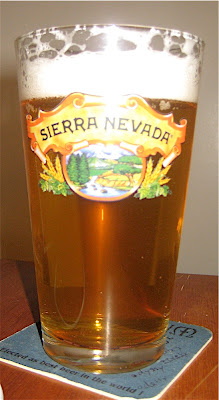 Here's the lowdown:
OG 1.053 FG 1.011
AA 78.3% ABV 5.4%
IBU 38 SRM 8
93% U.S. Two-row
7% Crystal 60
0.4 oz Yakima Magnum 60 mins (19 IBUs)
0.5 oz Perle 30 mins (10 IBUs)
1.0 oz Cascade 10 mins
2.0 oz Cascade flameout
US-05
Brewed Oct. 21
Crash-cooled Nov. 3
Kegged Nov. 11
Tapped Nov. 25
At first it was a little "homebrewy" -- probably from the last of the yeast settling out to the bottom of the keg. The flavor profile continues to clean itself up. I have yet to purchase some real SNPA to do a side-by-side comparison, but I'd suspect it's going to be pretty close. The recipe is, after all, "renowned" (in its own circle anyway) for being a fine clone. If anything, it's possible this beer's hop character is a little subdued compared to the version coming out of Chico.
I've personally felt in recent years that SNPA seems fairly mellow for an American Pale Ale (probably not the case that beer's changed -- just that my tastes have). As such, this clone attempt, especially considering it might fall further on the mellow side, might even be best classified as some sort of "aggressive" Blonde Ale.
But it's all academic. This is a tasty brew no matter what.
Here's the lowdown:OG 1.053 FG 1.011
AA 78.3% ABV 5.4%
IBU 38 SRM 8
93% U.S. Two-row
7% Crystal 60
0.4 oz Yakima Magnum 60 mins (19 IBUs)
0.5 oz Perle 30 mins (10 IBUs)
1.0 oz Cascade 10 mins
2.0 oz Cascade flameout
US-05
Brewed Oct. 21
Crash-cooled Nov. 3
Kegged Nov. 11
Tapped Nov. 25
At first it was a little "homebrewy" -- probably from the last of the yeast settling out to the bottom of the keg. The flavor profile continues to clean itself up. I have yet to purchase some real SNPA to do a side-by-side comparison, but I'd suspect it's going to be pretty close. The recipe is, after all, "renowned" (in its own circle anyway) for being a fine clone. If anything, it's possible this beer's hop character is a little subdued compared to the version coming out of Chico.
I've personally felt in recent years that SNPA seems fairly mellow for an American Pale Ale (probably not the case that beer's changed -- just that my tastes have). As such, this clone attempt, especially considering it might fall further on the mellow side, might even be best classified as some sort of "aggressive" Blonde Ale.
But it's all academic. This is a tasty brew no matter what.
Monday, December 3, 2007
Check Your Thermometers
Not too long ago I brewed a beer, pitched my yeast, and thought all was going well. Then about eight days later I discovered fermentation had stopped well above where it should have (63 percent apparent attenuation versus the 78-81 I had been seeing with the same yeast).
I went and checked the thermometer I used to mash in and found it was reading five degrees higher than another one I had. I won't presume the second thermometer to be dead-on, but it does read exactly the same as my house thermostat, so I think it's in the neighborhood.
So what does this mean? I probably mashed closer to 160 degrees as opposed to the 155 I was aiming for. (And I only went that high because I thought the thermometer was actually reading high... HA!)
Moral of the story: check your thermometers. Don't take anything for granted. And if you suspect that a thermometer has been acting up on you and can't be trusted... you're probably right.
Tuesday, November 20, 2007
Celebration Time
 You know, this is a crazy world we live in. War, gas prices, AIDS, children with cleft palates... It can sometimes seem like more than a person should have to bear. But no matter what may be wrong with your life or your world, you can always take comfort in the annual mid-November release of the lovely Celebration Ale from Sierra Nevada Brewing Co.
Fans of hops are not to miss this gem of a brew. People complain that it gets less bitter every year -- I don't know about that; more likely, I think, we all continue to develop our hop tolerances.
It shows a fine fruity hop aroma to complement the signature flavors of American Cascade and Centennial hops, then finishes dry and bitter courtesy of a mostly Chinook-supplied 62 IBUs.
Oh, Celebration Ale... it's good to have you back.
Thursday, November 8, 2007
Witbier
I'll usually tell people that, as a general rule, I don't like wheat beers. But what I really mean by this is Bavarian and American wheat beers.
The truth, as usual, is more complicated. For this post I'll keep from delving into all the nuances of my real position on wheat beers -- the point right now is that I in fact have a true fondness for Belgian Witbiers.
The spiciness, the crispness, the faint citrus... To me, there's nothing quite like a well-made Witbier.
For that matter, there's nothing quite like enjoying a fresh Wit at a sidewalk cafe on a sunny afternoon in Belgium (or anywhere else in Europe, actually), but I digress. Suffice it to say, next time you're in Europe, consider it.
With all this in mind, I was excited to finally try my hand at brewing up a Wit. No real reason why it had taken me so long -- but you know, the list of beers to brew is usually lengthy enough that many are bound to spend a bit of time waiting.
Let me give you the specs on the Wit:
 OG 1.052 FG 1.009
AA 82% ABV 5.6%
IBU 17 SRM 3
51% German Pils
42% Flaked wheat
7% Flaked oats
0.5 lb rice hulls
12 IBU Saaz 60 mins
2 IBU Hallertau Mittelfrüh 60 mins
0.5 oz Tettnang 10 mins
0.25 oz Indian coriander (crushed) 10 mins
0.2 oz naval orange zest 10 mins
2 tbsp marmalade 10 mins
1 tbsp flour 10 mins
0.25 oz Indian coriander (crushed) flameout
0.2 oz naval orange zest flameout
1 tbsp flameout
White Labs 400 "Belgian Wit Ale"
* Some explanations: I had the Hallertau on hand so I threw it in. I used marmalade because I couldn't find actual Seville oranges, and I've read marmalade is made with the stuff. I used Indian coriander because I've read the "regular" version is no good for homebrew -- I then crushed it with a meat tenderizer (in a plastic bag) to bring out the goodness. The flour was intended to add that nice white haze that Wits are known for.
A few things jump out at me from this brew. First, the head formation and retention is miserable. This is especially puzzling given the beer is on the same manifold as all my other kegs and I have one regulator feeding pressure to all of them... and, I've had some foam issues with other beers of late, yet the Wit remains docile as ever. I want to say there are oils in the beer that are to blame. This could be psychosomatic, but I believe I get an oily sensation when I drink this particular brew. So if it is indeed oily, what's the source? The coriander or marmalade would be the most obvious culprits.
I had thought that I'd identified the coriander as the source of these troubles, since I presently have another coriander beer on tap that had displayed the same symptoms, except more recently that beer has "come around" in the head department... so I dunno... (But, that one also has more body in the first place, which logic would suggest means it would... ahem... "give better head"...)
But the second issue, and the one that bothers me more, is that the coriander comes on too strong in this brew. I thought I was being careful with my amount, consulting other recipes so as not to overdo it. Well, either my coriander is particularly potent, or I'm particularly sensitive to it, but either way, thar be too much here.
Next time, first of all, I'll cut down on the coriander, probably to 0.25 or 0.2 oz. I'll also restrict the coriander addition to flameout. Really, aroma is what I want, not flavor. This could be part of my problem.
Also, I think I'll mash at a higher temperature than the 149 degrees I recorded on this one. WLP400 seems to be a fairly high attenuator, and I think this beer could stand to have a fuller, smoother mouthfeel, so I'd say 153 or so should be in order.
Finally, I'll try to ferment the beer a little warmer on the next go-around. I've read that others have had great success with this yeast at high (80 degrees plus) temperatures, and given that I found its performance a little restrained this time, I don't see how warmer can hurt. Besides, now that it's getting colder, I don't run the risk of having my house temperature getting out of control during the day. (I won't use the fermentation fridge.) I'll ferment the next Wit at about 75 degrees ambient, which should push the fermentation temperature up around 80 or so. This should also help make up for backing off on the spice additions.
I have to say, I'd love to really nail this Wit. I can imagine few pleasures greater than having a steady supply of this pale yellow elixir at my fingertips, ready at a moment's notice for some quiet time out in the sun.
Friday, November 2, 2007
Dogfish Head Punkin' Ale
 So I missed Halloween by a couple days. Nevertheless, I had a bottle of DFH Punkin' Ale lying around, and I figured now was as good a time as any to dust it off.
Actually, it turns out now's not as good a time as then, because this particular sample, which dates from last fall's release, is past its prime.
I had read somewhere that Punkin' Ale drank pretty good at about a year old. So I held onto a bottle.
Well, the truth is that, while the beer isn't what I would call bad (and at 7% ABV I wasn't worried about rapid spoilage), it has nevertheless lost it spicy luster and thus much of its character.
Better would have been to hold back a few bottles and try them at intervals. I'm thinking three to six months would have been closer to ideal.
Wednesday, October 24, 2007
Chincoe IPA
Sometimes you just want a really hoppy beer, but you don't want to deal with a 9% alcohol Double IPA in order to get it.
With this in mind, I decided to make a beer hopped more like a DIPA, but with the malt bill of a regular-strength IPA. In other words, a perfectly hoppy out-of-balance beer. Not necessarily an original concept, I'm sure, but it seemed like a good idea.
So here's what I came up with:
 OG 1.060 FG 1.011
AA 80.9% ABV 6.4%
IBU 81 SRM 8
68% U.S. Two-row
26% Munich
4% Dextrine
1% Crystal 60
1% Crystal 120
0.5 oz Simcoe FWH
1.0 oz Chinook 60 mins
0.25 oz Chinook 30 mins
0.25 oz Simcoe 30 mins
0.25 oz Chinook 20 mins
0.25 oz Simcoe 20 mins
0.5 oz Chinook 0 mins
0.5 oz Simcoe 0 mins
1.0 oz Chinook dry hop
1.0 oz Simcoe dry hop
US-05
So, you can see why I dubbed this "Chincoe IPA." Between the IBUs and the high attenuation, this one finishes dry as a bone.
Next time, I think I'll load up more on the late hop additions -- like two or three times the amount. Maybe more dry hops too. OK, and maybe more character malt. But like I said, it wasn't supposed to be balanced. Just an extra hoppy beer of manageable strength.
Subscribe to:
Posts (Atom)
