


The beer world has been mildly abuzz for the past day over British beer writer Roger Protz's scathing criticism of a new beer coming out of Scotland that claims to be the world's strongest. Tactical Nuclear Penguin, from BrewDog Ltd in Fraserburgh, is an iced Imperial Stout that purports to have reset the bar at a whopping 32% ABV. In his blog piece, posted yesterday, Protz calls out BrewDog for "their over-inflated egos and naked ambition" and says that, at any rate, TNP doesn't actually count as beer because brewer's yeast tends to poop out at around 14% alcohol.
As might be expected, the comments section practically caught fire as the brewerati swept in to BrewDog's defense (some going more gentle on Protz than others in the process). Twitterers weighed in as well.
Today, Protz responded on his blog, admitting he may have been a wee bit hasty and careless in some of his prior comments, though this allowance didn't come until after Protz had reminded readers of his credentials and wondered aloud about those of his critics. Protz's followup, as much a call for civility as anything, also did not answer questions about why he seemed to take such issue with the basic notion of a high-alcohol beer (especially when it pushes no boundaries of beverage-alcohol strength in general).
As of now, an open question still remains: Why is it a foregone conclusion that TNP is "not beer at all," as Protz asserted? Certainly this is not the first beer to concentrate its strength via freezing, nor would it have been the first to incorporate a wine or champagne yeast if it had done so (there's no indication this is the case, but Protz originally suggested it was and seems to exclude such concoctions from his definition of beer). Plenty of beer aficionados – probably even plenty of beer writers as tenured as the distinguished Mr. Protz – would prefer to fixate on the source of the fermentables (here, grain) as being the chief criterion for what constitutes beer.
If nothing else, this is a huge boon for BrewDog as they will benefit from the added (free) publicity. But it's also a healthy debate to be having – one about traditional versus experimental; sessionable versus sippable; old guard versus new guard; and who gets to make the rules versus who should bother playing by them.
Showing posts with label Stout. Show all posts
Showing posts with label Stout. Show all posts
Tuesday, December 1, 2009

Sunday, October 4, 2009
The Session #32 – Eastern Beers
 Looks like I've taken a couple months off from participating in The Session, the monthly beer-blogging thing you can read about here. And when I do get on board, I usually do so a couple days late. Like this month.
Our task for Session #32, as assigned by Girl Likes Beer (and recapped here), was to "pick your favorite beer made east [from] your hometown but east enough that it is already in a different country. It can be from the closest country or from the furthest. Explain why do you like this beer. What is the coolest stereotype associated with the country the beer comes from (of course according to you)?"
For Americans, of course, this is an easy question given all the great beer over in Europe (i.e. east of us). I thought I'd try to make this interesting by seeing what beer-producing lands might fall along my same line of lattitude (around 34°) but seeing as how that line will take you through North Africa and the Middle East on the way to China, I'm not sure I have many options there. So anywhere east will have to do.
Having been lucky enough to have traveled to Europe a few times, I can easily pick from any number of delicious beer styles I've enjoyed in their homelands – from authentic, delicious English Bitter and Porter to the wonderful, unique and diverse Belgian ales and the lagers of Germany, Austria and the Czech Republic. For a beer lover, it's something of a pilgrimage to be able to enjoy a beer where and how it was meant to be enjoyed – hand-pulled ale in a cozy London pub; bright, revelatory Geueze in Brussels; liter upon liter of German lager so tasty and drinkable its nearly shameful; Pilsner Urquell that's about as delicious and fresh as it seems beer can be.
These are the easy answers, and there are more just like them. But seeking out great beer is not the only reason to travel; it's a sad truth that some of the world's highly interesting and beautiful places have hardly any beer culture to speak of. Shocking though this may be, it is manageable – not to mention a nice reality check for those of use who might take beer not only too seriously, but for granted also. It's during these times that the rare, unexpected moments of beer pleasure are all the more welcome and rewarding.
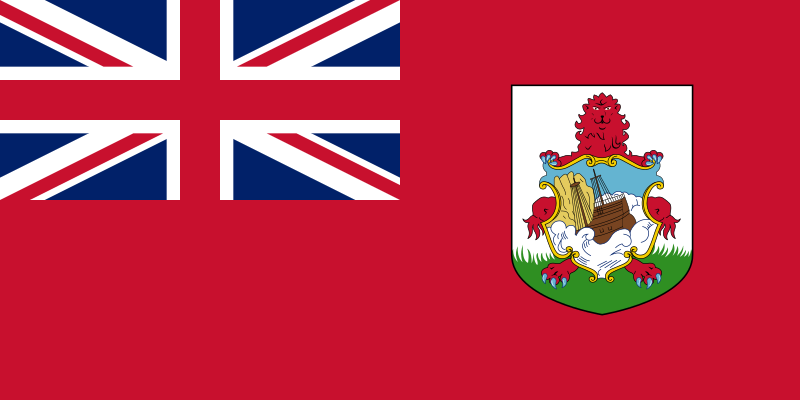 With all that in mind, I'll play it loose a little with this Session topic and revisit one such icing-on-the-cake beer moment I wrote about not long ago. In Bermuda this summer – despite its British heritage not exactly a land of great beer – I was more than content to soak up the beautiful water, weather and scenery of such a charming place. So it was all the more enjoyable when I found, at a simple cove-side food shack looking out upon a typically gorgeous Bermudian scene, real, tropical-style Guinness Foreign Extra Stout. The stronger stuff too, not the Canadian-brewed version we get in the U.S.
I hope Girl Likes Beer will pardon my flexible interpretation of her topic, as it bears noting that this Guinness wasn't actually brewed in Bermuda, only consumed there. Though, certainly, its eastern origin remains in place.
Beer historians connect Foreign Extra Stout with the tropics (it can even be called "Tropical Stout") due to the style's former, and to an extent present, popularity there – no doubt thanks to the one-time colonial presence of Stout-loving Brits in places like Jamaica and Bermuda. But for people who don't know of such things, so stout a beer is among the last things they'd associate with these island paradises. Rum and Red Stripe, yes. FES, not so much.
Back at the food shack, I would have been perfectly content to enjoy my pre-snorkel lunch in the company of an uncomplicated European macro-lager. Instead, I got confirmation of what select islanders already know – that a strong, roasty, bitter stout can be plenty satisfying in these tropical environs.
It goes to show that when you're least expecting it, great beer can sneak up on you and make a wonderful experience even better. And if the object of great beer isn't to enrich life, I'm not sure what it is.

This view and FES? I'll take it.
Wednesday, August 12, 2009
Beer in Bermuda
What can be said about beer on the otherwise lovely island nation of Bermuda? Unfortunately, not much – and that's a phrase that also describes both the quality and depth of the selection available on this Atlantic paradise.
Which is a shame, especially considering Bermuda's history and heritage. Founded by the English and still part of the United Kingdom, Bermuda is home to a handful of British-style pubs, which strictly speaking should probably be deemed more authentic than most such taverns found off the Queen's immediate turf. How appropriate, then, would it be to find quality British ales (to say nothing of cask-conditioned real ales) in the Bermudian environs, even if weather concerns demanded more in the way of easy-drinking Milds and Bitters, as opposed to Porters, Old Ales and the like.
Instead, we mostly find world lagers like the fairly ubiquitous Heineken, Carlsberg and Stella Artois, with the occasional Guinness and, perhaps surprisingly, Sam Adams sprinkled in. Yes, there's also Amstel Light along with the American Big Three.
Fairness compels me to make a few observations. First, one does not visit Bermuda for the beer selection. Beer geeks might instead focus on the gorgeous scenery and great snorkeling – two areas where Bermuda arguably trumps, say, a Brussels or a London. Second, there is at least one brewery on the island, more than can be said for many places around the world, though I can't speak to the quality of their wares as I did not have a chance to visit. Also, let's not forget that in a climate like Bermuda's, often your lighter lagers are just what the doctor ordered, and indeed one could do worse (one could also do better, but one could do worse) than Heinie, Stella, Sam Adams, and so on.
Lastly, I should mention the hidden gem known as Miles Market, in Hamilton, where a beer-starved visitor will likely to be shocked to find such high-quality offerings as Chimay, Saison Dupont, Victory, Dogfish Head, Westmalle, Paulaner and Fullers, among others. This selection is particularly surprising given that I did not see any of these beers for sale at restaurants or bars. And their mere availability at one spot makes the relative meagerness encountered elsewhere all the more unfortunate.
 The island isn't completely wanting for welcome treats when out and about. Real Guinness Foreign Extra Stout, that of the high-octane variety, can be found at otherwise hopeless (for beer, that is) joints like your beachside food shacks. (Now, Beer Advocate indicates there are also local versions of FES from Bahamas and Jamaica; I must say I don't recall reading on the label where Bermuda gets theirs from.)
Rich and hearty, yet strangely refreshing enough for tropical weather, FES affords a great chance to unwind in unique island style. Oh, and perhaps best of all, you can do so while enjoying this kind of view from the porch:

Which is a shame, especially considering Bermuda's history and heritage. Founded by the English and still part of the United Kingdom, Bermuda is home to a handful of British-style pubs, which strictly speaking should probably be deemed more authentic than most such taverns found off the Queen's immediate turf. How appropriate, then, would it be to find quality British ales (to say nothing of cask-conditioned real ales) in the Bermudian environs, even if weather concerns demanded more in the way of easy-drinking Milds and Bitters, as opposed to Porters, Old Ales and the like.
Instead, we mostly find world lagers like the fairly ubiquitous Heineken, Carlsberg and Stella Artois, with the occasional Guinness and, perhaps surprisingly, Sam Adams sprinkled in. Yes, there's also Amstel Light along with the American Big Three.
Fairness compels me to make a few observations. First, one does not visit Bermuda for the beer selection. Beer geeks might instead focus on the gorgeous scenery and great snorkeling – two areas where Bermuda arguably trumps, say, a Brussels or a London. Second, there is at least one brewery on the island, more than can be said for many places around the world, though I can't speak to the quality of their wares as I did not have a chance to visit. Also, let's not forget that in a climate like Bermuda's, often your lighter lagers are just what the doctor ordered, and indeed one could do worse (one could also do better, but one could do worse) than Heinie, Stella, Sam Adams, and so on.
Lastly, I should mention the hidden gem known as Miles Market, in Hamilton, where a beer-starved visitor will likely to be shocked to find such high-quality offerings as Chimay, Saison Dupont, Victory, Dogfish Head, Westmalle, Paulaner and Fullers, among others. This selection is particularly surprising given that I did not see any of these beers for sale at restaurants or bars. And their mere availability at one spot makes the relative meagerness encountered elsewhere all the more unfortunate.
 The island isn't completely wanting for welcome treats when out and about. Real Guinness Foreign Extra Stout, that of the high-octane variety, can be found at otherwise hopeless (for beer, that is) joints like your beachside food shacks. (Now, Beer Advocate indicates there are also local versions of FES from Bahamas and Jamaica; I must say I don't recall reading on the label where Bermuda gets theirs from.)
Rich and hearty, yet strangely refreshing enough for tropical weather, FES affords a great chance to unwind in unique island style. Oh, and perhaps best of all, you can do so while enjoying this kind of view from the porch:

Thursday, December 4, 2008
Economics vs. Tradition, As Usual
I have to thank on-top-of-it beer writer Lew Bryson for this scoop: Heineken NV will be closing its Beamish & Crawford brewery early next year.
Those who enjoy a Beamish now and then (and those, like me, who think it and Murphy's occupy the top two slots among the Dry Irish Stout Big Three) will be heartened to know that the Beamish brand won't be dying off – just that production will move to another Irish brewery of Heineken's (in Cork, like Beamish & Crawford) where, by the way, Murphy's is produced. How's that for consolidation?
Sunday, November 16, 2008
"Honey, I'm Off to the Pub. Yell if You Need Me."
What do you get the lush who thinks he has everything? How about his very own bar?
The folks at
 Imagine – it's a rainy Sunday morning and you're wide awake, stuck with nothing to do during that unfortunate time between sunrise and NFL kickoff. Worse, your favorite watering holes have all yet to open! Well, how about heading downstairs (heck, have it installed in your bedroom) to your own personal Irish pub for some liquid breakfast?
"Pull me some of that black stuff, Seamus," you say. But wait – there is nary a mutton-chopped, rosy-cheeked barman to be found. Oops! Lost in the moment, you forgot that at (Insert Your Name Here)'s Pub, you are the bartender! And the customer, and the owner, and the creepy drunk who mutters to himself at the bar and leers inappropriately at your wife. Anything goes, and "last call" is unheard of.
It gets better. To become properly oriented as an official Guinness bar owner, you and a friend will be shuttled to Dublin for a VIP tour (and, we can presume, overindulgent tasting binge) at the St. James's Gate Brewery, home of Guinness for nearly 250 years. But save some of that thirst, because waiting for you at home will be your own supply of fresh Guinness Stout. One year's worth.
If you think this little slice of personal heaven on earth doesn't come cheaply ... you're right. The price tag? Try a quarter million. Powerball tickets, anyone?
Thursday, September 25, 2008
Brilliant! Stout
Dry Stout is a misunderstood style, particularly when the general public is involved. (But isn't that always the case?) Sometimes called Dry Irish Stout due to its historical connection with and popularity on the Emerald Isle (Guinness, Murphy's and Beamish, Irish all, are the examples perhaps most likely to come to mind, in that order), here's a beer that tends to be light-bodied and low in alcohol (the three aforementioned brands being no exception) and yet is widely perceived as being the exact opposite – big, heavy, strong, overpowering.
Why? The first reason, of course, would be the color – jet-black and intimidating, not like those friendly, easy-drinking mega-lagers folks are used to. Then there's the flavor – strong (that is to say, existent), roasty, quite bitter. And finally the mouthfeel – a blend of CO2 and nitrogen (something many commercial examples, including the three above, feature) imparts a creamy, velvety texture to Dry Stout that is often taken for thickness, heaviness.
Of course, we homebrewers and beer snobs are wiser than this. Apart from its flavor – yes, Dry Stout is dark, coffee-like, rather bitter – there is in fact little in the way of alcohol content or body to put Dry Stout in the category of real heavyweights like Imperial Stout, Doppelbock and Barleywine.
Call Dry Stout session beer for a chilly day. Or for a hot day. Just don't call it "motor oil," and don't let your scaredy-cat pals call it that, either.
Here's my Dry Stout, very heavily based (hops and yeast being the differences) on a well-regarded recipe by Bob Girolamo.
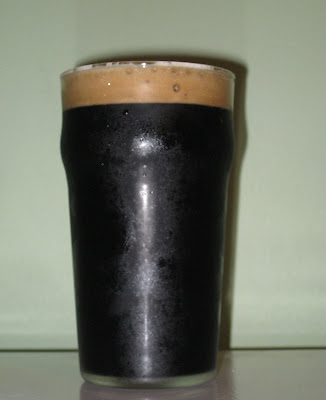 The details:
OG 1.056 FG 1.013
ABV 5.7% AA 76.5%
IBUs 44 SRM 33
80% Crisp Marris Otter
8% Flaked Barley
8% Roasted Barley
4% Crystal 120
1 oz Magnum 60 mins (44 IBUs)
US-05
As you can see, the alcohol content on this one is pretty high by Dry Stout standards. Partly that's because I hadn't gotten my mill yet so I had ordered precrushed grains from an online supplier. As such, I wasn't sure what kind of efficiency to expect, so I wanted to err on the high end with my order. (I ended up with ~74% efficiency. Not bad.)
The name, selected by my girlfriend, is an homage to the recent Guinness advertising campaign, although I will note that this brew was never intended as any kind of Guinness clone, and was served on just CO2.
Not surprisingly, based on accolades directed at Bob G.'s recipe, this one turned out very tasty. A big hit among my girlfriend (who loves Dry Stouts) and everyone else who came over to sample it. I didn't perform any experiments on dyed-in-the-wool light-beer drinkers, but based on my friends' feedback (surely they're not just being polite??) I'd venture to say Dry Stout's potential for wide appeal is not to be underestimated.
On a more somber note, this particular beer didn't make it through a recent party. It had a good life, and put many a smile on many a people's face. Wish I had a glass right now...
Saturday, August 23, 2008
Old Guinness
A friend of mine recently gave me some old beer he had going to waste in the back of his fridge. In the course of a conversation, it was revealed that some folks had brought beers to his place for a party, and that the brews had been sitting there, all alone and quenching no one's thirst, for a while. The time had come, he declared, to toss them out.
I might as well have been a dog rescuer who'd just heard an adorable Shih Tzu was about to be put down. Immediately I volunteered to take the unwanted beers off his hands. My friend's bemused reaction bordered on disapproval, as if I had just betrayed a most pathetic length to which I'd go in the name of alcohol. These beers, he informed me, were most certainly ancient and well past drinkable.
I had to calmly explain that, first, beer does not spoil – many beers can become fairly unpleasant after enough time, but not harmful to drink. Secondly, I was interested in sampling these relics not in the name of catching a cheap and dusty buzz but as an educational experience. The beer geek in me (he has a say in a lot of things) wanted to know what effects age had wrought on these beers.
Receiving my friend's castoffs, I noted that they did indeed have a couple years on them. A bottle of Samuel Adams Boston Lager bears a "best by" date of September 2006. Assuming all of the beers took up residence in my friend's fridge at the same time (and I'm lead to believe they did), and assuming the Sam Adams was not on in years to begin with, that would put these brews at over two years old.
 The haul included that Sam, a Carmel Wheat Beer (both of which I've not yet drank), a woefully insipid Bert Grant's Mandarin Hefeweizen, a Heineken with solid floaties and an unpleasant aftertaste (and of course I'm not blaming the beers here – these flaws came as no surprise), and two Guinness Draughts.
As I said, I assumed the age on these beers was two-plus years. Only the Sam has a date. One Guinness (pictured) has a code that appears to read "02L3." Not sure what, if anything, that means.
Now, considering the apparent age of this Guinness and its low alcohol (around 4.2% ABV), I'm a little surprised and pleased to report that it's not too bad. OK, so the bottle and bottle cap wore a little fridge grime. And the malt does seem to thin out some into an oxidized finish (something I'm not terribly sensitive to anyway), but then Guinness is also light-bodied already, creamy nitro-widget notwithstanding. The roast is there but not terribly strong, but the beer still retains a fair amount of bitterness (this being something else that typically wanes noticeably in older beers).
Would I have guessed this Guinness was so old? No, probably not. No doubt the fact that it and its brethren have been languishing in a refrigerator, and not on a store shelf or in a closet, has helped. On the other hand, let's not forget that the Mandarin Hefeweizen and Heinie presumably shared quarters with their Irish friend here.
I'm not about to recommend Guinness Draught as a cellarable beer. Yet, nor will I advocate that an aged sample should live out its final moments getting to know your kitchen sink. Remember, alcohol abuse is a crime in 17 states.
Subscribe to:
Posts (Atom)
