Sunday, July 6, 2008

The Pokal Pilsner Glass


Toss the word "pokal" into any Internet search engine and see what comes back. If Google et al. are to be believed, the pokal is little more narrowly defined as a beer glass than is, say, the pint glass. (In the case of the latter, do you mean a tumbler? A nonic? A tulip?)

Beeradvocate offers this: A pokal is typically "tall, slender and tapered" ... "a European Pilsner glass with a stem."

That's descriptive and potentially helpful, but how "slender" is this offering from Kulmbacher? This and other examples (how about this beauty from Sierra Nevada?) suggest that the pokal as a category is a flexible one – accommodating relative diversity in terms of height, roundness, stemmed-ness, and so on.

Let's go ahead and (OK, arbitrarily) take the glass at the right as our standard pokal. You'll note its tall, narrow body, footed design (in this case, no real stem per se, though it does offer a thick, narrowing base), and tapered mouth. On this last count the pokal differs from other Pilsner glasses you may have seen that feature a distinct flare at the top. (We'll discuss those at a future date.)

Certainly, Pilsner and other lighter beers are most logical choices for the pokal. Anything that is not too heavy on flavors or aromas, or color if you're interested in aesthetics, will find the pokal a comfortable fit. The more delicate the better. (But please – to a point. Let us say unequivocally that it's better to drink a Pils from this glass than an O'Doul's.)

The pokal's design is meant to show off a Pilsner's bright color and clarity. (That may sound like an obvious thing to say about a vessel made of glass, but in this case the pokal's elegant look serves to compliment the Pilsner's brilliance, delicate color, fluffy white head, crisp flavor, and so on. In this way, the refined-looking pokal is a proper match for Pils, which had historically been regarded as a beer of tantalizing luxury.) Also, the glass' tapered top should help gather up head and aromas.

Whatever its precise form, the pokal is likely to make just about any beer look good. And who can deny the allure of a well poured Pilsner (tall, blonde, and available), beckoning the prospective drinker from its elegant vessel?

MillerCoors is Up and Running


MillerCoors, the combined U.S. effort of Molson Coors and SABMiller, has begun operations as of this month.

Here's a press release.

The merger effectively leaves the U.S. with two major brewing behemoths. (The other, of course, being you-know-who.) It's funny – at a time when The Big Boys are seeing their sales drop while imports and craft beers continue to grow, the answer is to consolidate, consolidate, consolidate. (Actually, under that framework, InBev's proposed buyout of A-B is, somehow, both typical and ironic at the same time.)

The big brewers' insistence on More of the Same in the face of shifting consumer preferences is the industry's way of battening the hatches, digging in the heels. Too often the "solutions" these guys come up with – merge distribution channels to increase efficiency and create greater economies of scale; ramp up marketing efforts on behalf of core brands – betray either a tremendous ignorance of the real reasons behind BMC-types' struggles, or an astonishingly dismissive posture toward that reality, or both. Here's what it boils down to: If consumers are increasingly reaching for higher-end, more flavorful, and – saints alive! – pricier brews, the big guys' answer is always (a) find ways to streamline distribution (to what end – improve upon nearly 100 percent market saturation?) and (b) find a way to "reinvigorate" the marketing apparatuses behind brands that already are what they are thanks to years of very effective navigation of the highly competitive world of beer marketing.

And all this will ultimately serve the consumer how? Or respond to changes in the industry (really, changes in consumer tastes) how? Or, in MillerCoors' own words, "build the best portfolio of beer brands in the business" how?

In this last case, I hate to rain on Pete Coors' corporate flimflammery parade with a rational line of thought, but I fail to see how one gigantic macro-lager brewer whose portfolio consists largely of giant macro-lagers merging with another gigantic macro-lager brewer whose portfolio also consists of giant macro-lagers will represent a progression toward "the best portfolio of beer brands in the business." The most homogeneous, perhaps.

Oh, well. Let MillerCoors do what they want. I suspect they'll find this marriage, though unlikely to end in disaster, will not bear the fruit promised by their fanciful mission statement. But it's also unlikely that beer industry executives will stop viewing this kind of move as anything but another in the long line of highly successful maneuvers that have seen 80 percent of U.S. beer market share now consolidated in the hands of two players. It is, on some level – a very significant one, in fact – hard to argue with that kind of success.

It may be tempting to compare this mergers-and-acquisitions game to rearranging the deck chairs on the Titanic, but to do so would be exaggerating these companies' challenges, and clichéd, besides. A percentage slip here and there might be millions of dollars off the balance sheet, but there's plenty of space between today's stock price and rock bottom. The icebergs are small and negotiable yet.

Monday, June 30, 2008

Belgian Pale Ale


Ah, Belgium. Or, as it ought to be officially known, beer-geek heaven.

Home to the funky and the sour, the super-strong and slightly less than super-strong, the rare and the revered, the groundbreakers and the often imitated.

So, one can understand how a beer that does not, truth be told, fall in any of the above categories might slip through the cracks and largely miss out on the devotion and the accolades heaped on its brethren.

That is Belgian Pale Ale.

And yet, consider that this is a style that is among the most popular in its homeland – and in Belgium's case, as opposed to the U.S. and most of the rest of the world, a beer's popularity is not, in fact, inversely proportional to whether it's worth a damn.

Still, among American beer connoisseurs, Belgian Pale Ale (henceforth BPA) is an often overlooked style, disregarded in favor of bolder choices like Belgian Strong Dark and Gueuze.

But what makes BPA neglected also makes it great: namely, balance and harmony among ingredients and flavors. It's an average-strength beer, moderately malty, neither over- nor under-hopped, with a touch of restrained esters from Belgian yeast. In places like Antwerpen, especially, BPA serves as the equivalent of the English Bitter – easy-drinking and session-worthy. Antwerpen's De Koninck is the standard bearer for BPA.

So all that was roughly the idea when I set out to craft my own.

Here's what I came up with:

OG 1.049 FG 1.013
AA 73.7% ABV 4.8%
IBU 40 SRM 7

67% German Pilsner
17% German Munich
8% German Vienna
4% Aromatic
2% Biscuit
2% Crystal 20

0.77 oz Perle FWH (14 IBUs)
0.4 oz Yakima Magnum 60 mins (19 IBUs)
0.5 oz East Kent Goldings 20 mins
0.5 oz Saaz flameout
0.5 oz East Kent Goldings flameout

White Labs 400 "Belgian Wit Ale"

This yeast was chosen because I had it in my rotation for Witbiers and White Labs indicated this particular strain is appropriate for the style, besides. This was fermented in the high 60s to low 70s.

It has medium esters early on before sliding into a moderately dry and bitter finish. There's a little spice on the finish, as well, no doubt from the Witbier yeast. The nose is subtle on all fronts – some hops maybe and a little fruitiness, but not too much of anything sticks out.

I intentionally overshot the style guidelines on IBUs because, well, I was looking more for a reasonably hoppy Belgian beer and less so for a spot-on BJCP-approved specimen. Still, it's reasonably restrained for hophead standards.

This beer drinks easily and is a nice change of pace from the more steroidal Belgians we might normally reach for on the one hand, and the citrusy hop showcases we often find in Pale Ale-type beers (if you're drinking American and not English, of course) on the other.

Restraint and balance have their place, and they demonstrate their virtue in a lovely style like Belgian Pale Ale.

But one can't help but be enticed – how about a nice, outrageous Belgian IPA? ...

Thursday, June 26, 2008

Beer in Spain, Part Dos

Where the pickings are slim for on-premise beer oases, one can suspect the same, or worse, will be true on the retail end. That is the case in Barcelona, where “beer bars” (in this case, Belgian beer bars) can be counted on one hand, and quality beer shops, perhaps, on one finger.

La Cerveteca occupies an inconspicuous corner property on an inconspicuous side street not far from Barcelona’s harbor and La Rambla, the city’s main pedestrian drag and, as it happens, floral bazaar.

The shop itself also doubles as a bar and is laid out accordingly. Barrels in the front accommodate standing drinkers, while in the back there’s a cozy den complete with a bookshelf full of beery reads. Also intriguing is the glimpse into an unfinished cellar, the mouth of which sits beneath a case housing an impressive collection of glassware.

Of course, La Cerveteca (reviews here and here) features Spanish beers, but these are – thank heavens! – not named Damm or Mahou; still, the owner says most of them are equally worthless. One brand, however, makes the grade: Companiya Cervesera del Montseny, from a town called Sant Miquel de Baleynà. They brew a hoppy pale ale called +Lupulus that's pretty decent – it may or may not, subjectively speaking, be of especially high quality, but for the hop-starved European traveler, it’s like heaven. The dark ale +Negra also scores points on flavor and general European unconventionality.

Germany is represented at La Cerveteca as well. Best of the bunch would probably be Schlenkerla, the famous smoked-beer brewers from Bamburg.

Belgium claims most of the store’s shelf space. Secular brews like Kwak and Duvel are on hand, plus a good showing of trappists (but of course, no Westvleteren). But the real treat would have to be Cantillon, represented here by a number of the brewery’s offerings. Given this beer’s limited production and availability, it’s not entirely unsurprising to find the stuff at this little shop in Barcelona. Though, whatever troubles were undertaken in bringing Cantillon to this spot are reflected in the prices.

But if one isn’t expecting to find Cantillon in this little Barcelona shop, the selection of American beers might be more surprising. Anchor and Flying Dog have surfaced elsewhere in Europe before (see Amsterdam’s De Bierkoning), but coming across Left Hand and Great Divide was a first for this traveler.

Among the U.S. brews for sale: Anchor’s Old Foghorn; Flying Dog Snake Dog IPA and Gonzo Imperial Porter; Left Hand Guju Ginger and Milk Stout; and Great Divide Titan IPA and Yeti Imperial Stout. In a state of delirious hop deprivation, it’s tempting to reach for an expensive bottle of American IPA to ward off those serious withdrawal symptoms. But that temptation should be avoided, if possible.

You know, when in Rome and all that.

Thursday, June 19, 2008

On Beer in Spain

The interesting thing about Europe is, when it comes to beer, it can be pretty much hit or miss. The continent is, after all, where most of the world's great beer styles were conceived, and accordingly, Europe is home to some of the oldest, most well developed, and most appreciative beer cultures there are. Consider the contributions made by places like Belgium, Germany, Czech Republic, and England to the global beer scene, and to the diverse array of finely crafted brews to which that culture is dedicated. Oh, and the likes of Ireland, Scotland, and Austria are no slouches either in the beer department.

But while significant pockets of Beervana do indeed beckon the Europe-bound beer traveler, there is, unfortunately, as much — OK, more — European geography where beer remains mired in mediocrity, woefully unglorified, and eons, it would seem, from attaining the status it enjoys elsewhere on the continent.

In these places, major brewing consortia along with perhaps one or two large regional or national breweries dominate the scene. The offerings are typically as limited as they are homogeneous: standard macro-lagers, as few as one to a bar, with names like Heineken or Amstel. Or, if we're being "local," it might be Kronenbourg or Damm or whatever the national beer of country X happens to be.

There is some good news. Many mass-produced European lagers are in fact more flavorful and enjoyable than their American counterparts. Doubtless this is accomplished by not overwhelming the beer with adjuncts (corn or rice, often) as Budweiser and Miller do. I am no student of the history of European consumerism, but I would suspect it's true that while the U.S. was being hit with the wave of Wonder-Bread-and-instant-coffee homogeneity that started sweeping through just after the second half of the 20th century, and also coincided with the rise of the macro-lagers that still dominate America today, Europeans' tastes for local, artisanal, and quality products had largely remained intact.

But still, absent a great tradition of flavorful beers in the first place, what we find available today still largely caters to the tastes of the masses, which in places like Spain invariably means light, easy on the palate, and drinkable.

And so it was that we, shortly after our rickety old train had crossed the frontier between France and Spain, found some suds in the dining car to which the above description neatly applies. Mahou Cinco Estrellas was its name, a standard lager brewed in Madrid by Grupo Mahou-San Miguel, which is not to be confused with the San Miguel brewed in the Philippines by an entirely different company. Maybe the long train ride was getting to me, but this Mahou stuff was not terrible. Not great, but not terrible. I'd certainly take it over a Bud Light.

Oh but wait — let's not get too carried away lionizing European megabrews. The aforementioned S.A. Damm brewery of Barcelona, Spain, makes a product called Estrella Damm. It is exceedingly common in Barcelona and the capital, Madrid (Mahou Cinco Estrellas isn't too unheard of, either). But in this case, Estrella Damm might as well be Miller Lite. Flavorless by light lager standards, it is even more so by European standards. All the more pity that any given Spanish bar is ulikely offer much else to fall back on.

That is why the serious beer traveler will not risk visiting just any Spanish bar. As with other European towns (Paris, Amsterdam) that lack their own serious beer culture, the bigger Spanish burgs like Barcelona, Madrid, and Zaragoza will have a few hidden jewels for the devotee willing to do a little advance research. Also, as with other European cities in this category, the beer oases in question will just about always take the form of an Irish pub or a Belgian beer joint. This stands to reason — the pub is a universally known paradigm of beer-drinkery, and Belgian beers are known through the world (at least among those who care) as being among the finest.

Irish pubs will tend to abound more so than Belgian bars, as you might expect. And, also predictably, you're apt to find Guinness in just about any such pub or perhaps Murphy's Red as your local-swill alternative. Hey, something is better than nothing.

Seek, therefore, the Belgians. Barcelona has a couple — Belchica has a handful of taps plus a wide array of bottles, including even a case of Westvleteren that, though full, is sadly for display purposes only — as does Madrid. In Zaragoza, one of the town's most impressive (perhaps the most impressive; I did not have time to scout the competition) Belgian beer bars is to be found, albeit temporarily, at the World Expo 2008. You see, countries from around the world create their own exhibits for the expo, and Belgium's features an impressive bar that offers some of that country's finer brews (including a few Trappists and the wonderful yet all-too-elusive Poperings Hommel Bier) among an impressive draft and bottle list. The expo ends in mid-September, but luckily Belgium won't be taking all the Belgian beers out of Zaragoza with them — this as evidenced by the handy Belgian beer pubcrawl guide the Belgians created for the expo. According to the pamphlet (again, time did not permit personal inspections), there are roughly 20 spots in town that serve at least one Belgian beer. As a further reassurance, two of said bars are named "Beerland" and "The Temple of Beer." Not too shabby, Zaragoza.

More musings on Spanish beer to come...

Wednesday, June 11, 2008

Brand X Gets an A

It makes sense for things like aspirin, toilet paper, and shampoo.

But buying generic, store-brand beer?

Don't laugh – here in the Luberon Valley in Provence, France, that's not such a bad idea. At least not in the opinion of this thirsty traveler.

Super U is the big local grocery store serving small area towns like Cadenet, Lourmarin, Puyvert. As with U.S. markets, the U sells its own in-house line of products ranging from pistachios to nail polish remover. Yet unlike any American grocery store I've been to with the (best I can recall) lone exception of Whole Foods, Super U also carries a house-brand beer. And unlike Whole Foods' Lamar St. line of brews, the Super U stuff actually has the store's logo on it.

Light, crisp, and refreshing, Blonde Beer (that's its name, you see) is a perfectly quaffable light lager in the continental tradition (that is, no adjuncts – unlike just about any American lawnmower swill – if I'm not misinferring from the label). Hovering in the middle of 4 percent ABV, and with a pleasing flavor to boot, this beer is almost too easy to drink. I say "almost" because drinkability is nothing to complain about.

Oh, and at around five euro for a 24 pack of 25-cl bottles, it's a bargain. For those scoring at home, that's the equivalent of almost 17 12-ounce servings for somewhere in the $7-8 range. And consider that flavor is usually the very first to be sacrificed when dealing with such price points stateside.

Beer: truly the ultimate affordable-luxury item.

Sunday, June 8, 2008

View from a Hilltop


Life sure can be tough sometimes.

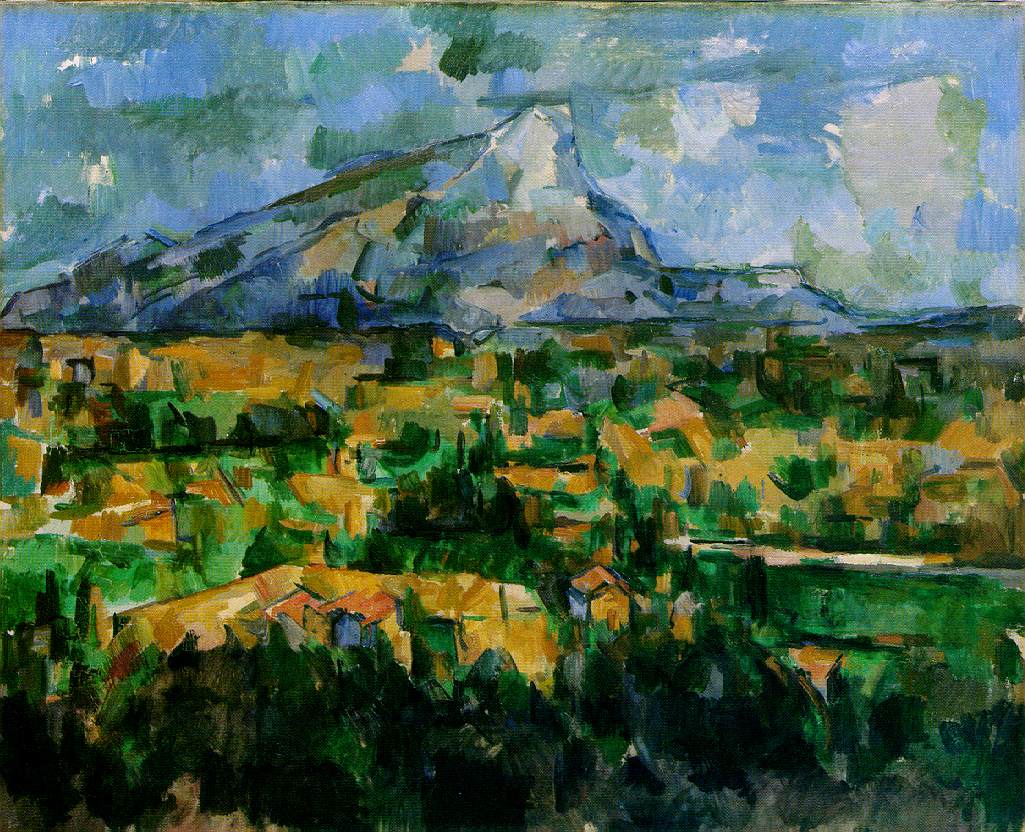
Take right now, for instance. Here I am perched on a mountain in Cadenet, France (in Provence), having to put up with an absurdly lovely view of the Luberon valley below and Cézanne's Mont St. Victoire in the distance.

Oh, the humanity.

To deal with this agony, I've resorted to sipping on nice, refreshing Witbiers on the back patio of our private villa. In such trying times, one does what one can.

Here's a watercolor to memorialize the experience. Below is the real version.

See what I have to put up with?

Related Posts with Thumbnails